
Architecting Autonomy: Why the Future of Delivery is Spec-Driven and AI-Accelerated
Introduction: The Death of the Bloated Ticket
The hallmark of a struggling development cycle is the 14-day mark: the moment a team realizes a feature is too large to test and too complex to review. This results in "Large Artifacts" — feature branches that remain open for weeks, accumulating technical debt and architectural drift.
This system replaces that chaos with a structured framework for clarity. It treats the sprint not as a moving deadline, but as a fixed execution window. The core transformation lies in "Shifting Left" — moving the heavy lifting of design and validation to the beginning of the process to ensure that once work starts, the path to "Merged" is clear.
From Coder to "Spec-Architect"
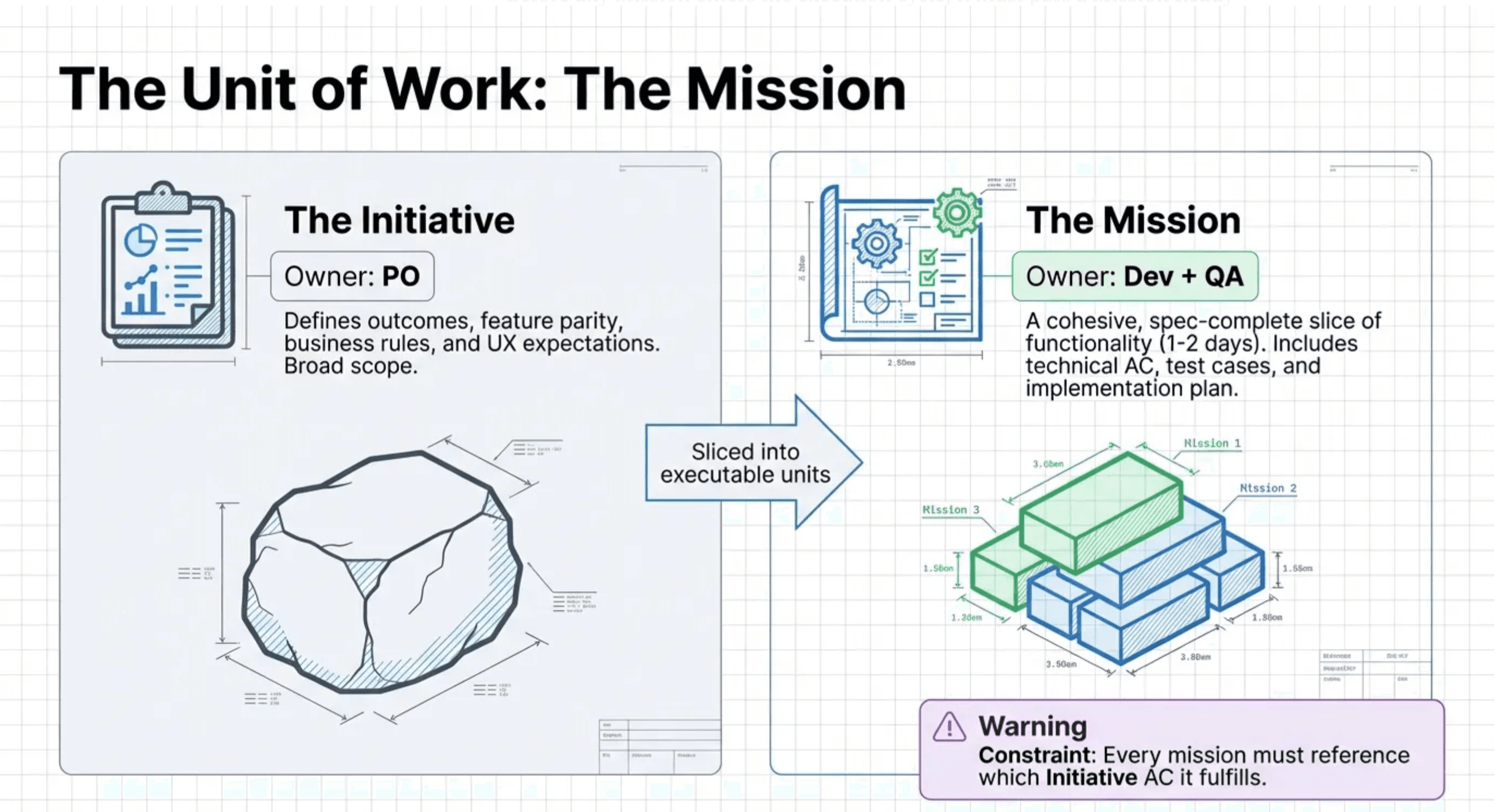
In this system, the roles of Developers and QA evolve during the Shaping phase. They are no longer just implementers; they act as Spec-Architects. While the Product Owner (PO) provides the roadmap and initiative-level outcomes, the team is responsible for the technical design before a single line of code is written.
During Shaping, Spec-Architects are responsible for:
- Splitting Initiatives into "Missions": Breaking down large roadmap items into executable tasks.
- Defining Mission-Level AC: Creating granular, executable slices of functionality.
- Establishing the Technical Contract: Writing the first draft of test cases before implementation begins.
By shifting these responsibilities left, the team creates a "Source of Truth" that guarantees the implementation is not just feasible, but inherently testable.
"The PO owns the 'Why' and 'What.' The Team owns the 'How we slice.'"
The Magic of the 1–2 Day "Mission"
The atomic unit of work in this system is the Mission. To ensure success, we must distinguish between two vital constraints:
- The Design Constraint (1–2 Days): Every mission is intentionally sliced into a cohesive, spec-complete unit intended to be completed in 1 to 2 days.
- The Execution Constraint (2 Weeks): This is the fixed window where all planned missions must be implemented, tested, and merged.
By shrinking the unit of work to 1–2 days, the team guarantees the success of the 2-week merge window. Small missions are easier to review and test, preventing the "Large Artifact" problem where feature branches become too bloated to manage.
Before any Mission enters the execution cycle, it must pass a Mission Ready Check:
- PO Alignment: Does this slice fulfill the roadmap intent?
- DEV Implementability: Is the technical path clear?
- QA Testability: Are the acceptance criteria and test cases defined?
Phase 1: Preparation and Shaping
Before any implementation begins, work passes through the Preparation and Shaping phase.
- Roadmap Definition: The Product Owner (PO) defines high-level initiatives, including the high-level Acceptance Criteria (AC) that serve as the "source of truth".
- The Spec-Architect Mindset: During the Shaping stage, Developers and QA engineers act as "Spec-Architects". Their responsibility is to read the initiative AC, identify mission slices, and define the mission-level AC and technical contracts.
- Mission Ready Check: To ensure a smooth transition to execution, missions undergo a lightweight alignment check where the PO, Dev, and QA sign off on the mission's implementability and testability.
Phase 2: The 2-Week Execution Cycle
Approved missions enter a fixed 2-week execution window. All missions planned within this cycle must be implemented, tested, and merged within this timeframe.
- Mission Queue Alignment: At the start of the cycle, Dev and QA plan the next two weeks, ensuring the increments are guaranteed to merge.
- Implementation and AI Collaboration: Developers and AI tools (such as Claude) collaborate during implementation. This process, known as Spec-Driven AI Test Generation, involves using AI to generate the baseline for E2E tests, including PageObjects, PageFunctions, and Spec Files directly from component source code.
- QA Handover and Validation: The philosophy is that AI generates the baseline, while QA engineers review, validate, and extend these tests to cover complex edge cases.
AI as the New Baseline for Quality Assurance
Quality assurance is no longer a final hurdle; it is a continuous, AI-assisted process. Using a Spec-Driven AI Test Generation workflow, we leverage LLMs like Claude to automate the repetitive aspects of test creation.
The technical bridge is the data-qa attributes. When a developer implements a component, they add these specific attributes to the source. Claude then uses the component source and implementation details to generate the necessary infrastructure:
- PageObjects: Structured representations of the UI.
- PageFunctions: Reusable logic for component interaction.
- Spec Files: The test definitions for end-to-end (e2e) validation.
This creates a "QA Handover" where AI provides the baseline of quality. This allows our human QA experts to move beyond manual regression and focus on high-value tasks: reviewing existing e2e tests, validating the baseline, and creating additional tests for complex edge cases.
Ownership Matrix: Clarity at Every Level
Autonomy is achieved through a clear Support Topology. Specialized roles exist to handle the planning overhead. This allows the PODs to focus exclusively on Mission execution.
A system built for speed requires clear autonomy and ownership:
- Initiative Level: The PO defines the outcomes (the "Why" and "What").
- Mission Level: Dev and QA collaboratively define the AC (the "How we slice").
- Test Validation: QA formalizes the testing process.
- Implementation: Handled by a partnership between Dev and AI.
By adopting the Spec-Architect mindset and leveraging AI for test automation, teams can ensure that high-quality software is delivered in predictable, rapid increments.
Conclusion: The Blueprint for Autonomy
The transition to PODs, Specs, and AI-driven testing creates a high-confidence delivery environment. The mystery of whether a feature will make it into a release is eliminated by a rigorous Status Progression lifecycle. To maintain transparency and a "production-ready" state, every mission follows a standardized status lifecycle: Workable → Working → Review → Test → Merged. A mission is only considered complete once auto-tests pass and the mission successfully meets the 2-week execution constraint.
By moving work through this cycle in small 1–2 day bursts, teams maintain a constant "Ready to Merge" state. This system requires a fundamental mindset shift: treating the preparation and shaping phase as the most critical part of the build.
As you evaluate your current workflow, ask yourself: Is your two-week sprint a true execution window for planned work, or is it just a rolling deadline for unplanned debt?